
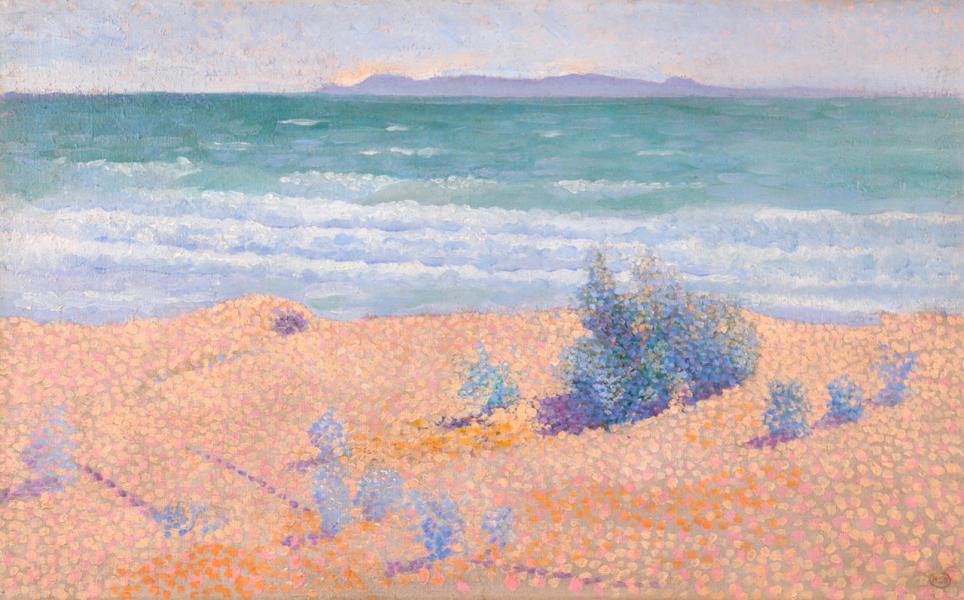
Etude pour Plage de la Vignasse, 1891-1892
Oil on canvas, oval studio stamp “HEC” (Lugt 1305a) lower right
37.80 x 60.50 cm
Related work :
Study for the painting Plage de la Vignasse, Les Îles d’Or, 1892 (oil on canvas, 65.5 × 92.2 cm), exhibited at the Salon of the Société des Artistes Indépendants, 1892.
Collection of the Musée d’art moderne André Malraux, Le Havre (accession no. 2004.3.32).
Provenance :
Artist’s studio
Private collection, Paris
Galerie Schmit, Paris, c. 1969–1981
Private collection, Massachusetts, acquired in 1981
Galerie de la Présidence, Paris
Private collection, Belgium
Exhibitions :
Cent ans de peinture française, Galerie Schmit, Paris, May–June 1969, no. 69, ill.
Tableaux de Maîtres français, 1900–1955, Galerie Schmit, Paris, May–June 1973, no. 11, ill. p. 27.
Choix d’un amateur, 19th–20th centuries, Galerie Schmit, Paris, May–June 1977, no. 21, ill. p. 23.
10th Biennale des Antiquaires, Galerie Schmit, Grand Palais, Paris, September–October 1980, no. 15 (ill.).
Literature :
Jean Sutter, Les Néo-Impressionnistes, Ides et Calendes, Neuchâtel, 1970, p. 65.
Patrick Offenstadt, Henri-Edmond Cross, Catalogue raisonné de l’œuvre peint, 2022, p. 56, no. 52 (ill.).
Certificate of inclusion in the artist’s catalogue raisonné issued by Patrick Offenstadt.
Very close to Cabasson—the end of the world where Henri-Edmond Cross chose to settle with his companion Irma Clare in 1891, the year in which he left the capital for the South—the beach of La Vignasse became a subject of choice for the painter. Georges Seurat had just died, and the Neo-Impressionists, with Paul Signac at the forefront, were deeply affected. In defending his pictorial legacy, they found a form of consolation after the premature loss of their friend. The group was certain of it: Seurat had opened the way toward a decisive new manner, one that embraced modernity. In moving south and encountering its light, Cross would, in his own way, pursue this ambition. There he painted his first landscapes that bear witness to a shift in his handling toward Neo-Impressionism. The wild nature he had come to find there inspired a transformation he had already begun in his Paris studio, as evidenced by the large full-length portrait of his companion shown at the Salon des Indépendants in 1891 (Musée d’Orsay, accession no. RF 1977 127).
Initially coming to the South to care for his health, this man of the North would find in the southern light a catalyst for his pictorial evolution. Far from urban agitation, in silence and calm, in a form of contemplation and solitude perhaps, the Var countryside presented itself to the painter as a rediscovered Eden, an Arcadian stage upon which to bring his artistic ideal to fruition.
“Hills of pines and cork oaks gently come to rest in the sea (…). Corners of charming intimacy abound alongside great fairy-like or decorative aspects. Yes, these two epithets best correspond to the sensations I experienced.”
Letter from Henri-Edmond Cross to Paul Signac, quoted in Paul Signac by Françoise Cachin,
Bibliothèque des Arts, 1971, p. 51.
Initially housed opposite Fort de Brégançon in the “Maison Perdue” upon his arrival in Bormes-les-Mimosas, Cross eventually settled in Saint-Clair, where amenities were closer at hand. There he built the house in which he would live until his death in 1910. He returned to the capital only once a year, at the time of the Salons. He was not isolated, however, and painter and writer friends visited him often. His friend Théo van Rysselberghe was his closest neighbour. Signac was not far away either.
The painting presented here is one of the works characteristic of the artist’s evolution toward Neo-Impressionism. The first version of a larger canvas shown at the Salon des Indépendants in 1892—acquired by the collector Olivier Senn at the time of the dispersal of the artist’s studio after his death and forming part of the donation now held at the MuMa Le Havre—this Plage de la Vignasse is of interest on several levels. It first bears witness to a clear formal investigation, to the contrast Cross sought to establish between the treatment of the foreground, with its distinctly divided brushwork, and that of the sea and sky, more classical, as if the artist did not yet dare to fragment the entire surface of the canvas. Seeking this contrast ardently, he would later succeed in creating it not through a differentiation of handling but through the palette itself, within his divisionist technique, by using strokes of pure colour no longer nuanced with white.
This Plage de la Vignasse is also moving: probably one of the first paintings executed by the artist in the South of France, just after his arrival in Cabasson, the canvas shows how Cross approached the Mediterranean shores—with humility and patience, perhaps somewhat dazzled by the overly strong light, which he had not yet fully learned to master.